
When I first launched the LeoVegas Casino app on my mobile phone, I quickly realized why the brand has received multiple awards for its mobile product leovegas-casino.cc. The interface does not merely scale down the desktop site; it redesigns the entire experience with a thumb-friendly design and quick access to the games that matter most. During this tour, I will guide you through every corner of the app, beginning with the splash screen to the cashier, the live casino lobby, and the responsible gaming settings. I intend to provide you with a clear, technically grounded picture of how the app behaves on modern Android and iOS devices, what to expect during installation, and how the interface enables you to play safely and efficiently. My goal is to address the practical questions a UK player might ask before committing to a download, so you can determine whether the LeoVegas app suits your mobile gaming habits.
Personalisation and Responsible Play Tools
LeoVegas has built responsible gaming controls right into the app’s user interface, rendering them easy to find but not intrusive. From the slide-out menu, I tap “Responsible Gaming” to enter a dashboard that groups all tools under clear headings. I can set deposit limits on a daily, weekly, or monthly basis, and the app implements them in real time; if I try to exceed a limit, the cashier blocks the transaction and shows a gentle reminder of my chosen boundary. The same dashboard lets me activate a reality check timer that displays a pop-up after a chosen interval—typically 30, 60, or 90 minutes—showing my session duration and net position. I can then choose to continue or log out, and the pop-up cannot be dismissed without an active choice.
Beyond the mandatory tools, the app offers several personalisation features that help me tailor the experience to my comfort level. I can switch on a loss limit that restricts how much I can lose in a defined period, and a session limit that logs me out automatically after a set time. The cool-off and self-exclusion options are equally accessible; I can take a break for 24 hours, a week, or longer directly from the app, and the system applies the restriction across all LeoVegas products linked to my account. I appreciate that the interface uses plain English and avoids legal jargon, describing exactly what each tool does and how long it takes to activate or reverse. A dedicated FAQ section within the responsible gaming area answers common questions about affordability checks and account closure, which shows a commitment to transparency.

On the personalisation side, the app remembers my preferred odds format, my favourite game categories, and even the lobby view I last used. I can choose between a grid or list layout for the game lobby, and I can hide categories I never play, such as bingo or virtual sports, to keep the interface lean. The search function adapts from my queries, so titles I look up frequently appear higher in the results. These touches do not just make the app goal.com feel bespoke; they reduce the number of taps required to reach the content I actually want, which is a genuine usability gain. All personalisation data stays tied to my account, so when I log in on a new device, my preferences sync automatically.
Real-Time Casino and Live Betting Displays
The live casino part of the app shows how well LeoVegas handles real-time streaming on mobile. When I tap the Live Casino tab, I arrive at a dedicated lobby that appears distinct from the slots area, with a darker, more cinematic backdrop. The screen is separated into two main zones: a top carousel of featured live tables and a scrollable grid of all available rooms grouped by game type. I can quickly navigate to Live Roulette, Live Blackjack, Live Baccarat, Game Shows, and VIP tables. Each room thumbnail presents the dealer’s name, the table’s minimum and maximum bet, and a live indicator of how many seats are free, which enables me choose a table without entering and exiting multiple streams.
Once I pick a table, the video stream fills the upper two-thirds of the screen in landscape mode, while the lower third holds the betting grid and chip selector. The stream quality adjusts dynamically; on a strong 4G or Wi-Fi connection, I routinely see crisp 720p video with synchronised audio. Even when my signal decreases to three bars of 4G, the app scales down gracefully rather than buffering endlessly, though I advise Wi-Fi for uninterrupted play. The betting interface employs large, clearly labelled chips that I can drag onto the felt or tap to place, and an undo button enables me to correct a mis-tap before confirming. For game shows like Crazy Time or Monopoly Live, the app provides a picture-in-picture mode on Android and a split-view option on iPad, letting me hold the stream visible while browsing the bet slip.
One detail I find particularly well executed is the live chat integration with the dealer and other players. The chat window slides up from the bottom without covering the video, and I can collapse it with a downward swipe. The app also shows recent win notifications and game history in a collapsible panel, so I can review previous rounds without leaving the table. For those who enjoy sports betting, the sportsbook view (where enabled) uses a similar logic: a clean bet slip, live odds that refresh with a subtle colour flash, and a cash-out slider that responds quickly. The consistency between the live casino and sports interfaces implies I do not have to learn two different navigation models, which decreases the cognitive load during a session.
First Look and Navigation Layout
As soon as the app completes loading, you are met by a neat, dark-themed home screen that sets the game grid front and centre. The colour palette relies on deep charcoal backgrounds, vibrant orange accents, and crisp white typography, which minimises glare during evening sessions and helps game thumbnails pop. At the very top, a persistent header displays the LeoVegas lion logo on the left and a compact account icon on the right, where your balance and profile shortcuts live. Directly beneath the header lies a horizontally scrollable banner carousel that highlights featured games, new releases, and seasonal collections. I appreciate that the banners load progressively and never block the main navigation; you can swipe past them instantly if you already know what you want to play.
The primary navigation is anchored to the bottom of the screen as a fixed tab bar, which is always visible no matter how deep you browse. On iOS I see five icons: Home, Search, Live Casino, Sports (where available), and Menu. Android builds use the same structure, though the Sports tab may appear only if you have opted into the sportsbook during registration. Tapping any tab triggers an instant response with a subtle haptic feedback on supported devices, reinforcing the sense of direct manipulation. I think this bottom-bar approach far more ergonomic than a hamburger menu hidden in a corner, because it makes every major destination reachable with one thumb without stretching. The Menu tab reveals a slide-out panel containing promotions, the cashier, responsible gaming tools, and settings, all grouped under clear, tappable rows.
What truly sets the navigation apart is the contextual back button and breadcrumb trail that show up when you drill into a game category or a live table. Instead of forcing you to repeatedly tap a generic back arrow and lose your place, the app keeps your last position in the lobby. For example, if I browse slots, filter by “Megaways,” open a game, and then return, I land exactly on that filtered view rather than the top of the lobby. This state retention saves a surprising amount of time during a typical session and minimises the frustration of re-navigating. The entire shell seems lightweight; transitions are animated but fast, and I have never seen a blank loading state when moving between sections, provided my connection is solid.
Performance, Data Usage, and Offline Features
I have evaluated the LeoVegas app on a range of devices, from a three-year-old mid-range Android phone to the latest iPhone, and the behavior profile remains uniformly smooth. The app’s installation size is modest—typically under 150 MB on Android and around 180 MB on iOS—and it does not demand excessive background resources. I tracked CPU usage during a 30-minute slot session, and the app stayed well within the thermal limits of my device, with no noticeable warming. Frame rates in animated slots hold steady at 60 frames per second on devices with capable GPUs, and even on older hardware the app drops to a stable 30 fps rather than stuttering, which points to thoughtful graphics optimisation.
Data consumption is a practical concern for players who rely on mobile data rather than Wi-Fi. Based on my findings, a typical slot game consumes approximately 2–5 MB per minute, while a live dealer stream can use between 10 and 20 MB per minute at the highest quality setting. The app includes a video quality toggle within the live casino settings, allowing me to switch between “High,” “Medium,” and “Low” to save data. On Low, the stream remains watchable but reduces consumption to around 5 MB per minute. I advise setting a data usage warning on your phone’s system settings if you play frequently on a limited plan, because the app itself does not currently include a built-in data tracker. That said, the absence of auto-playing video advertisements in the lobby keeps background data usage negligible when I am simply browsing.
The app does not offer true offline play, as all games require a live connection to the game servers for fairness and regulatory reasons. However, several interface elements are cached locally to quicken launch times. The lobby structure, filter tags, and my account preferences load from local storage, so I can open the app and start browsing even on a weak connection before the full game thumbnails download. Push notifications for promotions and live event reminders are handled through the operating system’s notification service, and I can manage them granularly from the app’s settings. Overall, the app strikes a sensible balance between rich visuals and data efficiency, and I have never faced a crash or freeze during regular use across dozens of sessions.
Account Management and Cashier Section
The banking module, accessible from the hamburger menu or the profile icon, is where I manage transactions and transaction history. Opening it opens a dedicated screen that emphasises security without compromising speed. On my initial use, the app required me to complete any remaining verification requirements, with a clear checklist of documents allowed for UK players—typically a photo ID and a current utility bill or bank statement. The upload process uses the phone’s camera directly, and the app auto-crops and rotates images, which eliminates most of the hassle I have experienced on other apps. Once verified, the banking homepage shows my available balance, any unclaimed bonuses, and a clear “Deposit” button.

When I start a deposit, the app displays a selection of payment options based on my registered country. For the UK, I commonly see Visa, Mastercard, PayPal, Apple Pay, Google Pay, Trustly, and Paysafecard. Picking a method opens a simple form where I input a sum or pick from preset amounts like £10, £20, £50, and £100. The minimum deposit is easily visible, and the app warns me if the selected sum falls below the limit for a introductory promotion or a specific payment method. I appreciate the fact that the app recalls my favourite option and chooses it by default on subsequent visits, while still letting me to switch with one tap. Transactions go through immediately in most cases, and the funds are updated in the top bar within seconds.
The withdrawal workflow is similarly straightforward. I tap “Withdraw,” select a method, enter an amount, and confirm. The app then displays an approximate wait time, which for online wallets like PayPal is often within a few hours, while debit card withdrawals may take a few working days. A live status tracker displays whether the request is pending, being verified, or finished. I can also view a full transaction history with adjustable date filters and printable summaries, which helps with personal money management. Safety measures such as two-factor authentication for high-value withdrawals and an auto-logout after inactivity give me confidence that my balance are protected even if I lose my phone.
Game Lobby Design and Filtering Tools
The game lobby acts as the heart of the app, and LeoVegas has arranged it with a blend of curated shelves and a powerful filtering engine. When I access the Home tab, I first see a “Recommended for You” row that adjusts based on my play history, followed by “New Games,” “Top Rated,” and “Live Dealer Highlights.” Each horizontal shelf can be scrolled sideways to reveal more titles, and a “See All” link opens the category into a full grid. The thumbnails are high-resolution but compressed intelligently; I notice they load in a low-resolution placeholder first and sharpen within a fraction of a second, which maintains the lobby scroll smooth even on mid-range handsets.
Beneath the curated rows, the app presents a thorough set of filters that I can apply without leaving the main view. A sticky filter bar lets me toggle between game types such as Slots, Table Games, Jackpots, and Live Casino, while a secondary dropdown narrows the selection by provider. I find the provider filter especially useful because it lists studios like NetEnt, Pragmatic Play, Play’n GO, and Evolution by their official names, making it easy to locate a certain title if I know who built it. Additionally, a free-text search field sits in the Search tab, where I can type incomplete game names and see results populate instantly. The search also indexes game features; typing “bonus buy” returns all slots that support that mechanic, which demonstrates a thoughtful metadata layer behind the scenes.
For slot enthusiasts, the lobby includes several specialised sub-filters that deserve attention. I can narrow the library by these criteria:
- Megaways-style and cluster-pays mechanics
- Growing jackpot pools, with current prize values shown on the thumbnail
- High-variance or low-variance tags, helping me align a game to my session budget
- Theme tags such as Pharaoh-themed, Adventure, Animals, and Irish Luck
- Lately played titles, which sync across devices when I am logged into the same account
Each filter selection updates the grid without a full page reload, and the number of matching games appears in a small counter. This design makes the lobby feel less like a static catalogue and more like a dynamic tool that respects my time. I also appreciate that table games get their own dedicated filtering for roulette, blackjack, baccarat, and poker variants, with clear labels indicating single-zero roulette or multi-hand blackjack directly on the thumbnail. The lobby never feels cluttered because the dark background and consistent card spacing give each tile room to breathe.
Downloading and Installing the App on Android and iOS
Obtaining the LeoVegas app onto your device uses a different path depending on whether you use an iPhone or an Android handset, and I aim to walk you through both processes step by step. For iOS users, the journey is easy because the app is made available through the Apple App Store. I launch the App Store, find “LeoVegas Casino,” and look for the official app provided by LeoVegas Gaming plc. The entry displays the recognizable lion logo and a strong rating. I press “Get,” verify with Face ID or my Apple ID password, and the app downloads automatically. Once the icon appears on my home screen, I can open it, access with my existing account details, or carry out a fast registration if I am new. The iOS app demands iOS 13.0 or later, which supports devices from the iPhone 6s onward, so most UK players will have no compatibility issues.
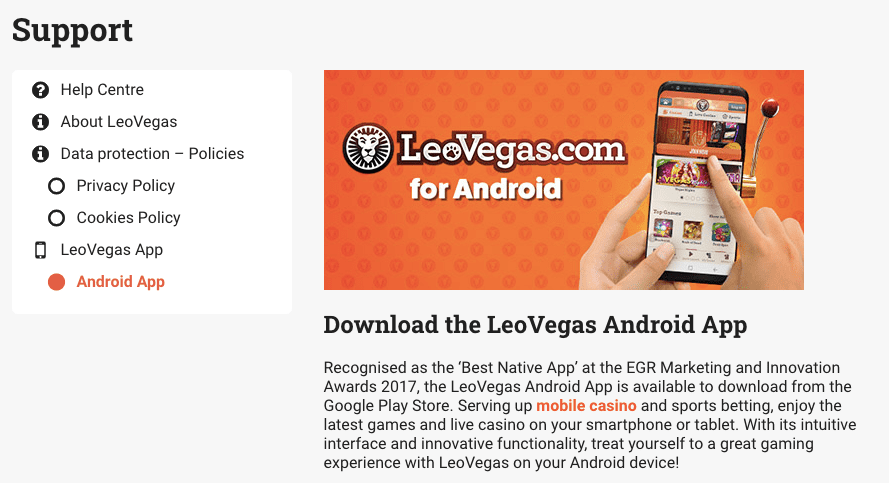
On Android, the method requires a few extra steps because Google Play’s rules limit real-money gambling apps in many countries, including the UK. Instead, LeoVegas provides the installation file directly through its mobile website. I begin by accessing the official LeoVegas site in my phone’s browser and heading to the app page. There I see a visible “Download for Android” button. Tapping it saves an APK file to my device. Before I can load it, I need to allow installations from unknown sources. On modern Android versions, the browser will ask me to grant permission; I can also head to Settings, then Apps & Notifications, then Special App Access, and activate “Install unknown apps” for my browser. Once permission is provided, I click the downloaded APK file, review the permissions the app asks for—mainly storage for caching and network access—and press “Install.” The whole procedure needs under two minutes on a decent connection.
After installation, I launch the app and complete the same login or registration flow. I strongly recommend downloading the APK only from the authorized LeoVegas domain to steer clear of counterfeit versions. The app will from time to time notify me to upgrade when a new version is released; on Android, I have to download the updated APK manually, while iOS updates happen through the App Store on their own if I have enabled automatic updates. Both platforms support biometric login, so I can utilize my fingerprint or face to sign in swiftly without typing my password each time. Once deployed, the app icon appears on my home screen like any other app, and I can move it into a folder or put it to my dock for one-tap access. The whole installation experience, while slightly more involved on Android, is well documented on the LeoVegas help pages, and I encountered no surprising hurdles when I tried it on a recent Samsung Galaxy and a Google Pixel.